01—04
Kaurlira · the earlier form
Four-face elongated die
- Elongated square-prism body
- Four equal long scoring faces
- Pyramidal ends that cannot become stable results
- Values 1–4
Physical game-object & system design
LIRA is a related family of elongated rolling objects, designed around four or eight equal scoring faces and pointed ends that cannot settle as results. The geometry is distinctive; more importantly, it has enabled several genuinely different game systems.

The physical object
Both forms share an elongated body and pointed end treatment. Only the equal long faces score. That gives the family a common silhouette while allowing games to choose between compact 1–4 and 1–8 ranges.
Kaurlira · the earlier form
Refine the square corners into four additional equal faces.
Oanlira · the later refinement

Form, finish and graphic language
The current visual direction pairs a polished black, onyx-like surface with gold Koorvenan numeral marks. Those marks make the object legible inside its fictional culture without changing the underlying probability range.
The finish and exact production glyph artwork remain a design direction. For the first prototype batch, the marks are supplied as surface-applied templates rather than cut into the solids. That keeps the geometry comparison controlled while preserving the established visual language.
Games native to the object
The same physical family supports both quick risk-and-bank play and a structured category-scoring game. Teyyru exists in a traditional four-Kaurlira form and a larger modern five-Oanlira form.
A push-your-luck doubling-out game. Players can use two Kaurlira, two Oanlira or one of each, deciding when to bank before doubles erase the turn total.


Play the evidence
These are isolated, single-visitor demonstrations: no account, campaign or parent Koraaver application is required. Each pairs the visitor with an automated House opponent so the governing rules can be experienced immediately.
Choose two LIRA, build a turn total and decide when to bank before doubles erase it.
Launch live demo80-space board game · You vs HouseRace, build, damage and complete towers using the signed-off movement and extra-turn rules.
Launch live demoThe larger design consequence
RIYYTRUU, LUUBRAK and Vaarek Varyn do not simply swap ordinary dice for themed props. Each assigns the LIRA ranges a different structural role in movement, selection, interruption or turn sequencing.
Two Oanlira test the rotating requirement ring. A successful test unlocks a Kaurlira movement roll; double 4 and double 8 interrupt the race by rotating the inner ring.
2 × Oanlira + 1 × Kaurlira
Two Oanlira drive movement around an 80-space route where players build, damage and complete towers. Doubles and completed towers can alter the turn rhythm.
2 × Oanlira
One Kaurlira selects a ring, the Oanlira sets exact primary movement and the second Kaurlira creates a move in the opposite direction. The three rolls have different jobs inside one turn.
2 × Kaurlira + 1 × OanliraRendered concept to printer handoff
The rendered Kaurlira and Oanlira concepts were reconstructed as parametric OpenCascade solids, held at an exact 70 mm overall length and issued in three controlled longitudinal-edge radii. The resulting handoff contains the geometry and evidence a 3D printer or prototype manufacturer needs to quote and produce the first comparison batch.
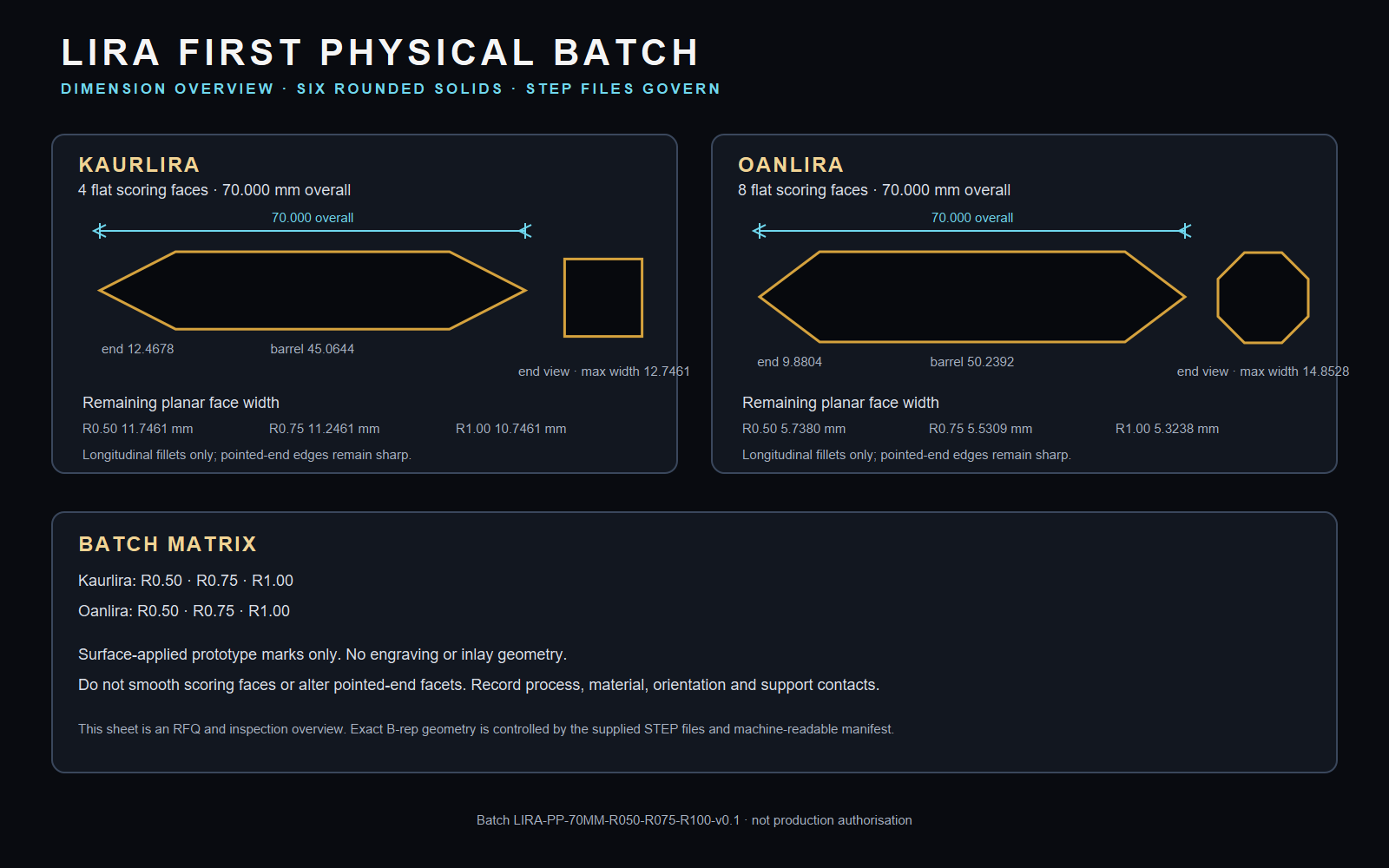
Two continuous solids preserve the flat scoring faces, pointed ends and intended proportions of the rendered forms.
Kaurlira and Oanlira are each supplied at R0.50, R0.75 and R1.00 mm, allowing one comparable prototype run.
STEP authority files, STL print files, marking templates and dimension sheets are packaged together for handoff.
A machine-readable manifest, file hashes and a one-command verifier confirm all six STEP solids and recorded outputs.
Evidence boundary
This case study demonstrates the complete path from rendered visual concept to a governed pack that can be handed to a 3D printer or prototype manufacturer: parametric CAD, controlled variants, STEP and STL geometry, marking templates, dimensional evidence, a frozen manifest and reproducible verification. It does not claim that a physical sample has been manufactured or tested, nor does it claim production tooling, material certification or a retail edition.
Start a conversation
Bring the complicated version. We’ll define what needs to work, agree a sensible scope and identify whether the right next step is discovery, prototype, build or deployment.